

Leadership in an Intensive Care Unit (ICU) should begin with a fundamental premise: not everyone should be a chief. The position requires a combination of scientific authority, clinical excellence, and organizational vision. A strong academic and professional curriculum is not merely symbolic; it provides credibility to lead specialized teams and sustain evidence-based decisions. The ICU chief must also be a competent clinician, capable of understanding bedside complexity and maintaining legitimacy among peers. Equally important is the ability to identify, attract, and retain highly skilled professionals, since system performance depends not only on leadership but on the quality of the team.
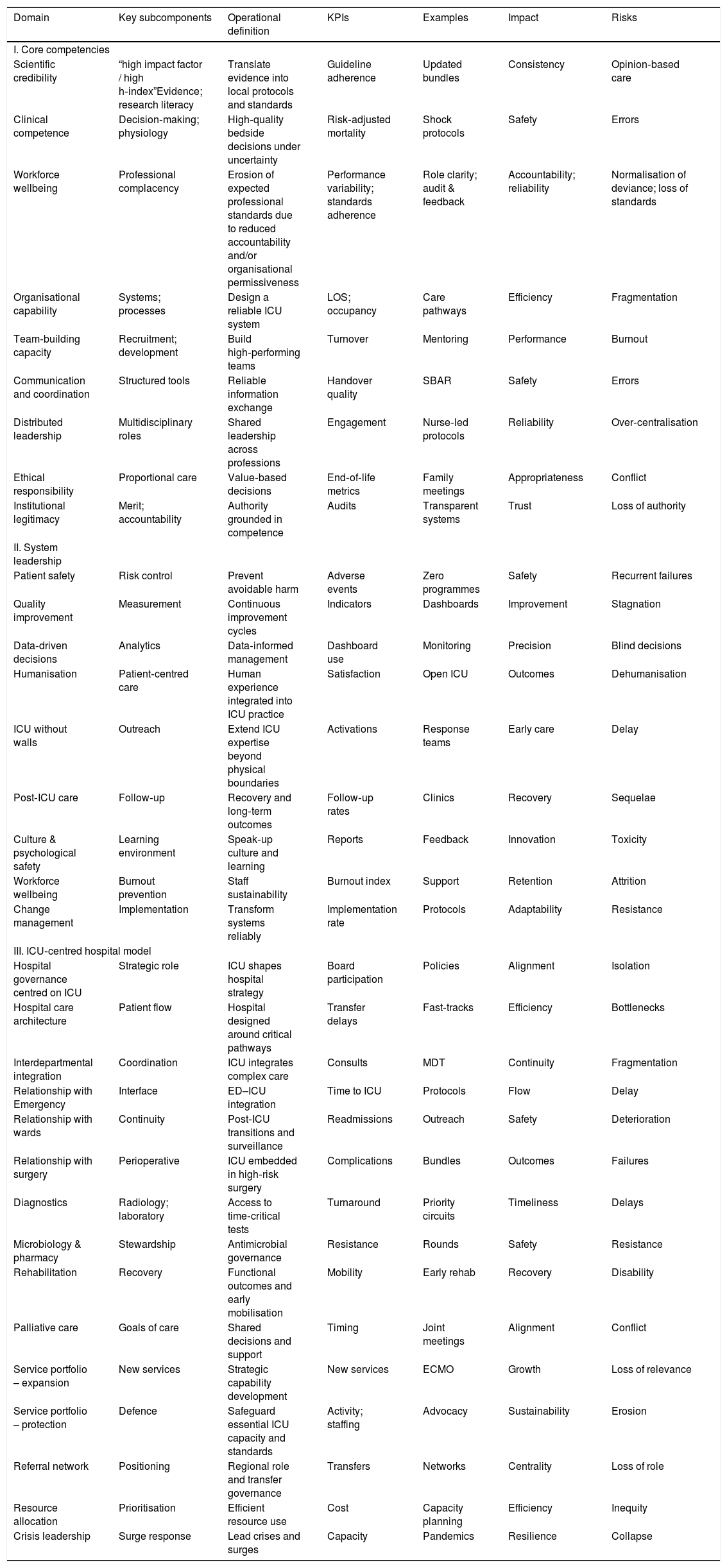
Leadership in an ICU is not symbolic nor the administrative culmination of a career; it is an exercise in clinical governance within a high-risk system. Organizational variability translates into variability in outcomes and patient harm. To lead is to design and sustain a reliable system that anticipates risk, prioritizes scarce resources, distributes responsibilities, and maintains a culture of safety based on measurement, transparency, and accountability. This systemic view understands the ICU not just as a physical space but as a coordinated clinical process.1Table 1.
ICU Leadership Framework: Core Competencies, System Leadership, and ICU‑Centred Hospital Model. Table 1 presents an integrative framework for Intensive Care Unit (ICU) leadership as an exercise in clinical governance within a high‑risk system. It operationalises leadership as the capacity to design and sustain reliable care through measurement, transparency, accountability and purposeful organisation, rather than as a purely administrative or symbolic role.
| Domain | Key subcomponents | Operational definition | KPIs | Examples | Impact | Risks |
|---|---|---|---|---|---|---|
| I. Core competencies | ||||||
| Scientific credibility | “high impact factor / high h‑index”Evidence; research literacy | Translate evidence into local protocols and standards | Guideline adherence | Updated bundles | Consistency | Opinion‑based care |
| Clinical competence | Decision‑making; physiology | High‑quality bedside decisions under uncertainty | Risk‑adjusted mortality | Shock protocols | Safety | Errors |
| Workforce wellbeing | Professional complacency | Erosion of expected professional standards due to reduced accountability and/or organisational permissiveness | Performance variability; standards adherence | Role clarity; audit & feedback | Accountability; reliability | Normalisation of deviance; loss of standards |
| Organisational capability | Systems; processes | Design a reliable ICU system | LOS; occupancy | Care pathways | Efficiency | Fragmentation |
| Team‑building capacity | Recruitment; development | Build high‑performing teams | Turnover | Mentoring | Performance | Burnout |
| Communication and coordination | Structured tools | Reliable information exchange | Handover quality | SBAR | Safety | Errors |
| Distributed leadership | Multidisciplinary roles | Shared leadership across professions | Engagement | Nurse‑led protocols | Reliability | Over‑centralisation |
| Ethical responsibility | Proportional care | Value‑based decisions | End‑of‑life metrics | Family meetings | Appropriateness | Conflict |
| Institutional legitimacy | Merit; accountability | Authority grounded in competence | Audits | Transparent systems | Trust | Loss of authority |
| II. System leadership | ||||||
| Patient safety | Risk control | Prevent avoidable harm | Adverse events | Zero programmes | Safety | Recurrent failures |
| Quality improvement | Measurement | Continuous improvement cycles | Indicators | Dashboards | Improvement | Stagnation |
| Data‑driven decisions | Analytics | Data‑informed management | Dashboard use | Monitoring | Precision | Blind decisions |
| Humanisation | Patient‑centred care | Human experience integrated into ICU practice | Satisfaction | Open ICU | Outcomes | Dehumanisation |
| ICU without walls | Outreach | Extend ICU expertise beyond physical boundaries | Activations | Response teams | Early care | Delay |
| Post‑ICU care | Follow‑up | Recovery and long‑term outcomes | Follow‑up rates | Clinics | Recovery | Sequelae |
| Culture & psychological safety | Learning environment | Speak‑up culture and learning | Reports | Feedback | Innovation | Toxicity |
| Workforce wellbeing | Burnout prevention | Staff sustainability | Burnout index | Support | Retention | Attrition |
| Change management | Implementation | Transform systems reliably | Implementation rate | Protocols | Adaptability | Resistance |
| III. ICU‑centred hospital model | ||||||
| Hospital governance centred on ICU | Strategic role | ICU shapes hospital strategy | Board participation | Policies | Alignment | Isolation |
| Hospital care architecture | Patient flow | Hospital designed around critical pathways | Transfer delays | Fast‑tracks | Efficiency | Bottlenecks |
| Interdepartmental integration | Coordination | ICU integrates complex care | Consults | MDT | Continuity | Fragmentation |
| Relationship with Emergency | Interface | ED–ICU integration | Time to ICU | Protocols | Flow | Delay |
| Relationship with wards | Continuity | Post‑ICU transitions and surveillance | Readmissions | Outreach | Safety | Deterioration |
| Relationship with surgery | Perioperative | ICU embedded in high‑risk surgery | Complications | Bundles | Outcomes | Failures |
| Diagnostics | Radiology; laboratory | Access to time‑critical tests | Turnaround | Priority circuits | Timeliness | Delays |
| Microbiology & pharmacy | Stewardship | Antimicrobial governance | Resistance | Rounds | Safety | Resistance |
| Rehabilitation | Recovery | Functional outcomes and early mobilisation | Mobility | Early rehab | Recovery | Disability |
| Palliative care | Goals of care | Shared decisions and support | Timing | Joint meetings | Alignment | Conflict |
| Service portfolio – expansion | New services | Strategic capability development | New services | ECMO | Growth | Loss of relevance |
| Service portfolio – protection | Defence | Safeguard essential ICU capacity and standards | Activity; staffing | Advocacy | Sustainability | Erosion |
| Referral network | Positioning | Regional role and transfer governance | Transfers | Networks | Centrality | Loss of role |
| Resource allocation | Prioritisation | Efficient resource use | Cost | Capacity planning | Efficiency | Inequity |
| Crisis leadership | Surge response | Lead crises and surges | Capacity | Pandemics | Resilience | Collapse |
Abbreviations: ICU, Intensive Care Unit; ED, Emergency Department; MDT, multidisciplinary team; KPI, Key Performance Indicator; KPIs, Key Performance Indicators; LOS, length of stay; SBAR, Situation–Background–Assessment–Recommendation; ECMO, extracorporeal membrane oxygenation; h-index, Hirsch index; DFM, Dual Failure Model (burnout vs professional complacency).
Concept note (DFM): In this framework, workforce wellbeing (burnout) and professional complacency are treated as two distinct but interacting failure modes. Burnout reflects depletion under sustained strain and calls primarily for recovery- and system-protection interventions; professional complacency reflects erosion of standards due to reduced accountability and calls for explicit expectation-setting, monitoring, and corrective governance.
KPI(s) (Key Performance Indicator[s]) are measurable metrics used to evaluate performance, quality, and outcomes of a system or service.
The framework is organised into three complementary blocks. First, Core competencies capture the individual foundations of legitimacy (scientific credibility, clinical competence and organisational capability), together with team, communication, ethical and institutional domains required to maintain authority at the bedside and within the organisation. Second, System leadership specifies the mechanisms through which an ICU becomes a high‑reliability service: patient safety and risk management, continuous quality improvement, data‑informed decision‑making, humanisation of care, outreach (‘ICU without walls’), post‑ICU recovery pathways, psychological safety, workforce sustainability and change implementation. Third, the ICU‑centred hospital model reframes critical care as an organisational hub, defining relationships with Emergency, wards, perioperative services, diagnostics, microbiology/pharmacy, rehabilitation and palliative care, while explicitly incorporating both service portfolio expansion (strategic capability development) and service portfolio protection (defending essential capacity and standards from erosion).
For each domain, suggested KPIs (Key Performance Indicators) provide measurable anchors that can be adapted to local dashboards, accreditation schemes and case‑mix adjustment, allowing the framework to be used as a practical governance tool (assessment, prioritisation and accountability) as well as a conceptual model for scholarship and policy.
This responsibility is also normative. In public systems, ICU leadership reflects principles governing public administration. The Spanish Constitution establishes that institutions must act objectively in service of the general interest, guided by efficiency and coordination. These principles apply directly: ensuring patient safety, equitable access, and appropriate resource use is both a professional and institutional obligation. Articles 23.2 and 103.3 establish equal access to public positions based on merit and capability. This framework underpins legitimacy in assigning responsibilities in a system managing scarce resources and life-affecting decisions. In this context, “everyone doing whatever they want” is not pluralism but organizational risk.
Leaders must recognize that failure is not only structural but may arise from professionals’ inability to fulfil roles. Intensivists may fail due to burnout or professional complacency—distinct but interacting impairments: exhaustion versus erosion of standards. The head must diagnose dysfunction, distinguish causes, and implement targeted responses. Burnout requires protective strategies; complacency demands reinforcement of expectations, monitoring, and corrective action. These interventions need support from hospital management to ensure legitimacy and durability. Failure to address them compromises system safety and may justify stepping down.
Planning becomes a form of indirect clinical intervention. Organizational variables—staffing, resources, care pathways—affect outcomes. The association between organization and outcomes, including intensivist staffing on mortality and length of stay, is well established.1 Frameworks such as SEMICYUC quality indicators and accreditation models translate planning into measurable improvement. Thus, planning is a core element of patient safety.2–4
Modern leadership also requires an expanded vision of care. The concept of “wall-less” ICU recognizes a continuum starting before admission and continuing after discharge. Early detection and timely intervention outside ICU improve outcomes, as shown in “UCI sin paredes” initiatives.2–4 This model integrates critical care across the hospital, ensuring continuity.
This perspective extends to post-ICU sequelae. Studies document persistent physical, cognitive, and psychological impairments in patients and families, highlighting the need for structured follow-up.5,6 Leadership must therefore integrate long-term outcomes into strategy.
At the core lies patient safety, now understood through a systems-based approach. Adverse events rarely stem from isolated errors; they arise from interactions between human factors, processes, and structures.4,5 Leaders must design environments that anticipate error, support safe performance, and promote learning, placing human factors and ergonomics at the centre.
Team dynamics are critical. ICU care depends on effective interprofessional collaboration; disruptive behaviors and poor communication threaten quality.7 Leadership must ensure clear roles, structured communication, and psychological safety. Leadership is distributed: nursing leadership at the bedside identifies problems, drives improvement, and maintains continuity, with positive effects on outcomes and satisfaction.8 The ICU should not function as a basic emergency service. Intensivists require medical and ethical expertise and must dedicate time to clinical care, teaching, and research.
Leadership alone is insufficient without appropriate structures. Structural and system-level factors may impact outcomes more than leadership behaviors alone.9 Alignment of processes, protocols, staffing, and measurement systems is essential. Risk-adjusted mortality and length of stay remain key metrics for evaluation and improvement.10 Active professional engagement with measurement and feedback increases reliability.
Structured programs illustrate effective leadership, such as “Neumonía Zero,” “Bacteriemia Zero,” and “Resistencia Zero.” These demonstrate how standardized bundles, monitoring, and multidisciplinary collaboration reduce complications and improve outcomes.11 They exemplify how leadership combined with structured processes and cultural change produces measurable benefits.
Quality also includes humanization of care. Open ICUs, family involvement, and patient-centered approaches improve experience and outcomes.12 Humanization is not optional but a structural component of quality, linked to safety and sustainability. 12
A key question arises: when should an ICU leader step down? This must be addressed ethically and professionally, not based on popularity or preference.
One indication is objective failure. Persistent inability to meet standards—poor outcomes, repeated adverse events, or failure to implement change—requires assessing whether responsibility can still be fulfilled. From a professional and constitutional perspective, failing to deliver effective care is failing to serve the general interest.9 Stepping down in such cases is responsible, not weak.
A more nuanced situation is lack of team support. It is essential to distinguish unpopularity from loss of functional legitimacy. Effective leadership often generates resistance when enforcing standards or change; thus, being disliked is not a reason to resign. However, when lack of support prevents implementing changes, maintaining cohesion, or ensuring safe function, the situation becomes critical. Trust breakdown can compromise the system, making stepping aside necessary to restore functionality.
Ultimately, legitimacy rests on the capacity to sustain a safe, effective, coherent system. Leaders should remain while able to improve outcomes, drive change, and maintain team function; they should step down when these conditions are not met.
In conclusion, ICU leadership lies at the intersection of clinical expertise, organizational design, and public accountability. It is grounded in evidence, guided by ethical and legal principles, and validated by outcomes. It is not a permanent entitlement but a dynamic responsibility that must be continuously justified through the capacity to serve patients, professionals, and society.
Authors' contributionSole author who performed all work.
FundingI don't have any funding
I have no conflicts of interest.