


Communication impairment and dysphagia are frequent consequences of critical illness and may persist beyond intensive care unit (ICU) discharge,1,2 with potential detrimental effects on nutrition, airway protection, patients’ outcomes and participation in care, and quality of life. Speech-language therapists (SLTs), having specialized expertise for a comprehensive evaluation and treatment of both communication and swallowing disorders, are increasingly recognized as relevant members of multidisciplinary ICU teams.3 Indeed, early rehabilitation interventions in the ICUs are associated with improved outcomes, shorter hospitalizations and savings of healthcare costs.4 Nevertheless, ICU-based SLT availability, referral criteria, treatment intensity, and outcome assessment remain heterogeneous5: while it has become a standard in some countries, in many others it is a neglected need.
In our center (Circolo Hospital and Macchi Foundation, University Hospital of Varese, Italy) we have implemented an ICU-based SLT since 2021, working across our three ICUs (general, mixed and neurological-neurosurgical), for a total of 24 beds. The SLT is available 5 days per week, 7 hours per day.
We retrospectively collected data from one-year SLT activities (1st January-31st December 2024) to detail the interventions provided to the patients and evaluate their impact in our population of critically ill. All patients evaluated at least once during the study period were included.
Patients were evaluated upon request from the ICU medical team. Data routinely collected by the SLT and retrieved included demographics, diagnosis upon admission, ICU length of stay and mortality. The reason for SLT consultation, the interventions provided, and pre/post-treatment assessments were also collected. Specific SLT evaluations included the Functional Oral Intake Scale (FOIS),6 the Level of Cognitive Function (LCF),7 and the GIRBAS (Grade, Instability, Roughness, Breathiness, Asthenia, Strain) voice scale.8 Pre/post comparisons were performed with the Wilcoxon signed-rank test in complete cases. The study complied with the Declaration of Helsinki and the Guidelines for Good Clinical Practice. In compliance with the Italian Personal Data Protection Code (Legislative Decree 196/2003), as amended by Legislative Decree 101/2018 for alignment with the General Data Protection Regulation (GDPR, EU 2016/679), all patient data were pseudonymized and managed via a secure database to ensure strict confidentiality. Given the retrospective observational design and the inclusion of deceased patients, Ethics Committee approval was not required. The research was conducted for significant public interest in the field of health, as permitted under Article 110 of the Italian Privacy Code.
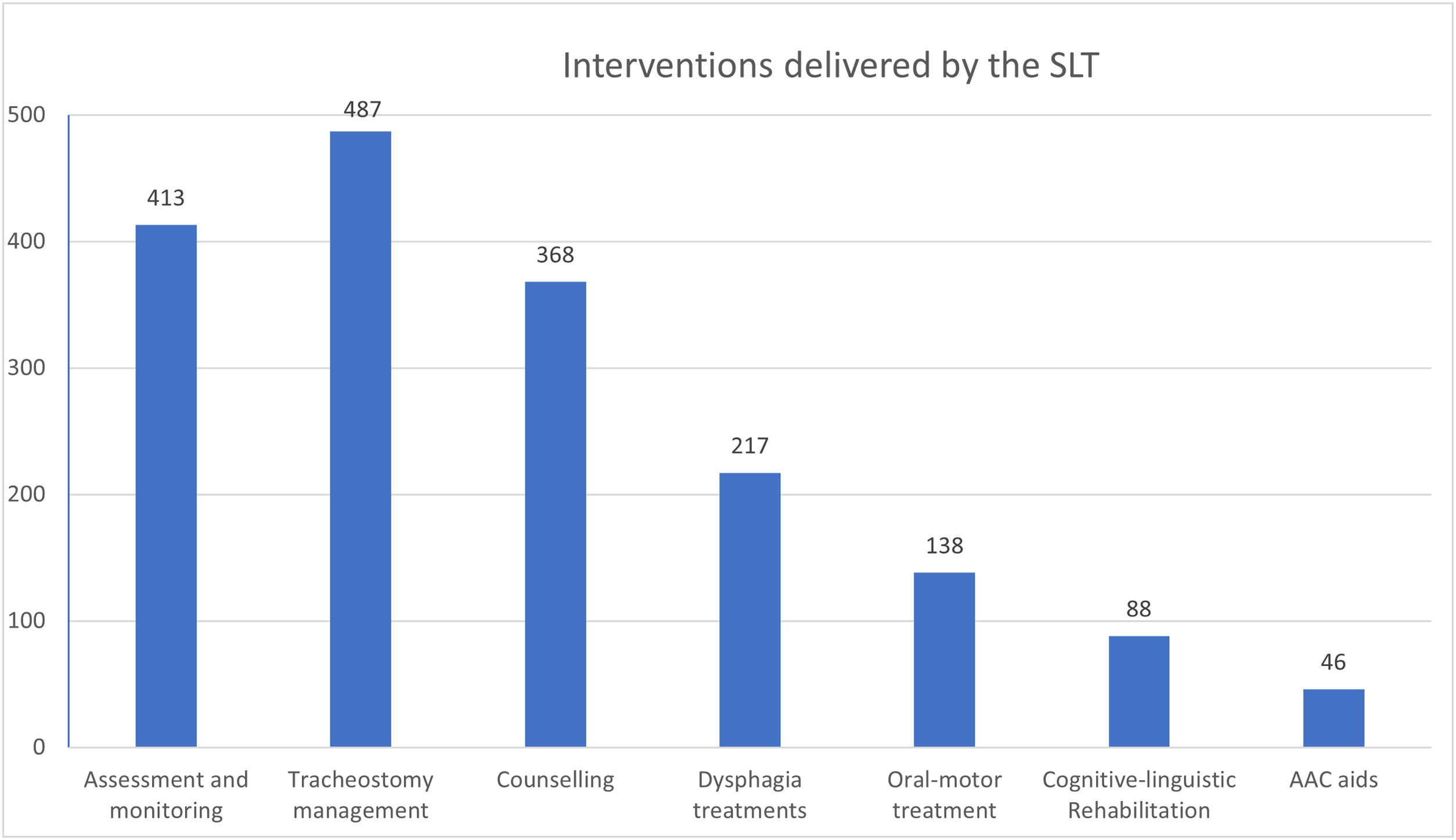
Among 1,266 ICU admissions, 137 patients (10.8%) received at least one SLT consultation. The median age of the referred patients was 63 years (IQR 42–75) and 87 (63%) were male. The 86% of patient population had either a nasogastric tube (n = 109) or a percutaneous gastrostomy (n = 9), and the 41% (n = 56) had a tracheostomy (patients’ characteristics are available within the supplementary material). The SLT consultation was more frequent for the neurological-neurosurgical ICU patients (64/347, 18.4%) than in the two general/mixed ICUs (73/919, 7.9%). The first consultation occurred usually after 9 days from ICU admission (median, IQR 4–14). Dysphagia and communication problems were the main indications, followed by dysarthria and dysphonia. Following the SLT evaluation, the vast majority of the patients (120/137, 87%) deserved a subsequent treatment (the characteristics of patients who were only evaluated or evaluated and treated are available in the supplementary material). Each patient received a median of 8 SLT interventions (IQR 4–17), including assessment, treatment, and counselling (Fig. 1); a description of the interventions provided is available in the supplementary material. Treatment duration was highly individualized (median 5 days, IQR 2–9; range 1–56).
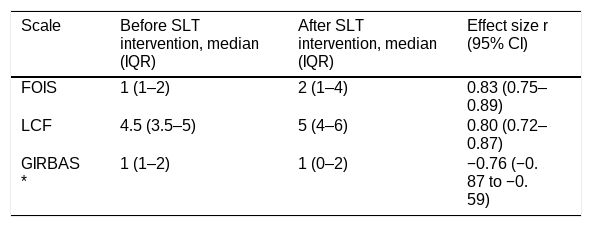
Among patients who were treated by the SLT, the functional oral intake, cognitive functions, and voice performances all improved after SLT intervention (Table 1). After the SLT treatment, 34 patients (29%) achieved a FOIS ≥4 (allowing a totally oral diet of a single consistency) compared with 7 (6%) before treatment, with 19 patients (16%) having only some food restrictions or no limitations at all (FOIS 6 and 7 respectively). The evaluation of the GIRBAS scale after the SLT treatment was consistent with a clinical improvement, with almost a quarter of patients presenting with at least a mild alteration of the voice at the first SLT evaluation, having improved after the treatment(n = 13/53 patients, for the GIRBAS lower scores indicate better voice quality).
Comparison of evaluations before and after SLT intervention among patients who were both evaluated and treated.
| Scale | Before SLT intervention, median (IQR) | After SLT intervention, median (IQR) | Effect size r (95% CI) |
|---|---|---|---|
| FOIS | 1 (1–2) | 2 (1–4) | 0.83 (0.75–0.89) |
| LCF | 4.5 (3.5–5) | 5 (4–6) | 0.80 (0.72–0.87) |
| GIRBAS* | 1 (1–2) | 1 (0–2) | −0.76 (−0.87 to −0.59) |
Abbreviations: FOIS, Functional Oral Intake Scale; LCF, Level of Cognitive Function; GIRBAS, Grade, Instability, Roughness, Breathiness, Asthenia, Strain; IQR, interquartile range; CI, confidence interval.
These data briefly describe the workload and the potential meaningful clinical contribution of a dedicated ICU-based SLT service in routine practice. The observed mix of swallowing rehabilitation, communication support, and care for patients with an artificial airways is consistent with previous evidence supporting structured communication interventions2,9 and dysphagia therapy in critically ill and post-intubation populations.10 Multidisciplinary pathways incorporating SLT have also been associated with improved outcomes in tracheostomized patients.4 In our cohort, the marked variability in the number, type and duration of sessions illustrates that SLT needs are not uniform and may depend on patients’ clinical condition, type of injury, airway status, and recovery trajectory.
The study has important limitations. Its single-center retrospective design, absence of a control group, referral based on clinician request, and use of a single SLT limit generalizability and preclude causal attribution of the observed improvements. Adverse events and patient-reported outcomes were not systematically collected, and GIRBAS could not be assessed in many intubated patients. Nonetheless, more than one in ten ICU admissions required specialist SLT evaluation, rising to almost one in five neurocritical patients, and possibly being higher if a systematic screening of patients’ needs were applied. Despite a limited number of patients included in our study, measurable functional improvements were observed among treated patients, thus suggesting the potential impact of SLT on our cohort, while highlighting the need for an ICU-based SLT to address several and different patient needs. These data support further prospective studies to define referral criteria, optimal timing and intensity of SLT intervention, and patient-centered outcomes, while including an health-economic evaluation to further justify a systematic implementation of SLT in the ICUs.
Authors’ contributionsAll the authors reviewed and approved the final manuscript. LC and AAG contributed to the revision of the data and manuscript. MBR contributed to the first drafting of the manuscript and data analysis. AC, EU, GS contributed to data retrieval and manuscript revision. GS, MBR and LC contributed to the conception of the study.
Human ethics and consent to participate declarationsThis study complied with ethical principles of the Declaration of Helsinki and the Guidelines for Good Clinical Practice. In compliance with the Italian Personal Data Protection Code (Legislative Decree 196/2003), as amended by Legislative Decree 101/2018 for alignment with the General Data Protection Regulation (GDPR, EU 2016/679), all patient data were pseudonymized and managed via a secure database to ensure strict confidentiality. Given the retrospective observational design of the study and the inclusion of deceased patients, Ethics Committee approval was not required. The research was conducted for significant public interest in the field of health, as permitted under Article 110 of the Italian Privacy Code.
Declaration of Generative AI and AI-assisted technologies in the writing processChatGPT was used to support the English linguistic revision.
FundingNone.
CongressNone.
Availability of data and materialsData will be available upon reasonable request to the corresponding author.
Clinical trial numberThe study was not registered.
The authors certify that there is no conflict of interest with any financial organization regarding the material discussed in the manuscript.
The following are Supplementary data to this article: