

Early administration of appropriate empirical antimicrobial therapy (AEAT) is a cornerstone of survival in patients with sepsis and septic shock admitted to the intensive care unit (ICU). Analysis of the Surviving Sepsis Campaign database demonstrated a linear increase in hospital mortality for each hour of delay in antibiotic administration,1 a finding reinforced by current international guidelines, which mandate antimicrobial initiation within one hour of sepsis recognition.2
Nonetheless, the aetiological precision required to move from empirical to targeted therapy is constrained by the inherent diagnostic latency of conventional blood cultures (BC), which typically require 24–72 h before pathogen identification is available.3 During this window, clinicians are compelled to prescribe broad-spectrum regimens, with the attendant risks of toxicity, selection of resistant organisms, and collateral ecological damage.4
Multiplex polymerase chain reaction (PCR) panels applied to positive BC have been shown to substantially accelerate pathogen identification and optimise antimicrobial therapy5,6; however, their use in the conventional workflow remains conditional on prior detection of growth by the automated incubation system.
We present the results of the MESIS (Molecular Early Sepsis Identification Study) pilot study, a registered prospective observational investigation (NCT05833412) approved by the local ethics committee (CEIM Ref. 182/2022) with waiver of informed consent. The study assessed whether off-label use of the BIOFIRE® Blood Culture Identification 2 (BCID2) panel, a multiplex PCR assay capable of simultaneously detecting 43 nucleic acid markers in approximately one hour, can detect microorganisms before a blood culture turns positive.7 Specifically, after incubating the blood culture for 6−8 h (BACTEC™ FX, BD), off-label BCID2 testing (BCID2-OL) was performed directly from all four BC bottles per patient. When a BC flagged positive conventional microbiological processing was then carried out following the local laboratory protocol. In parallel, a confirmatory BCID2 assay was performed on the positive BC bottle (Confirmatory BCID2).
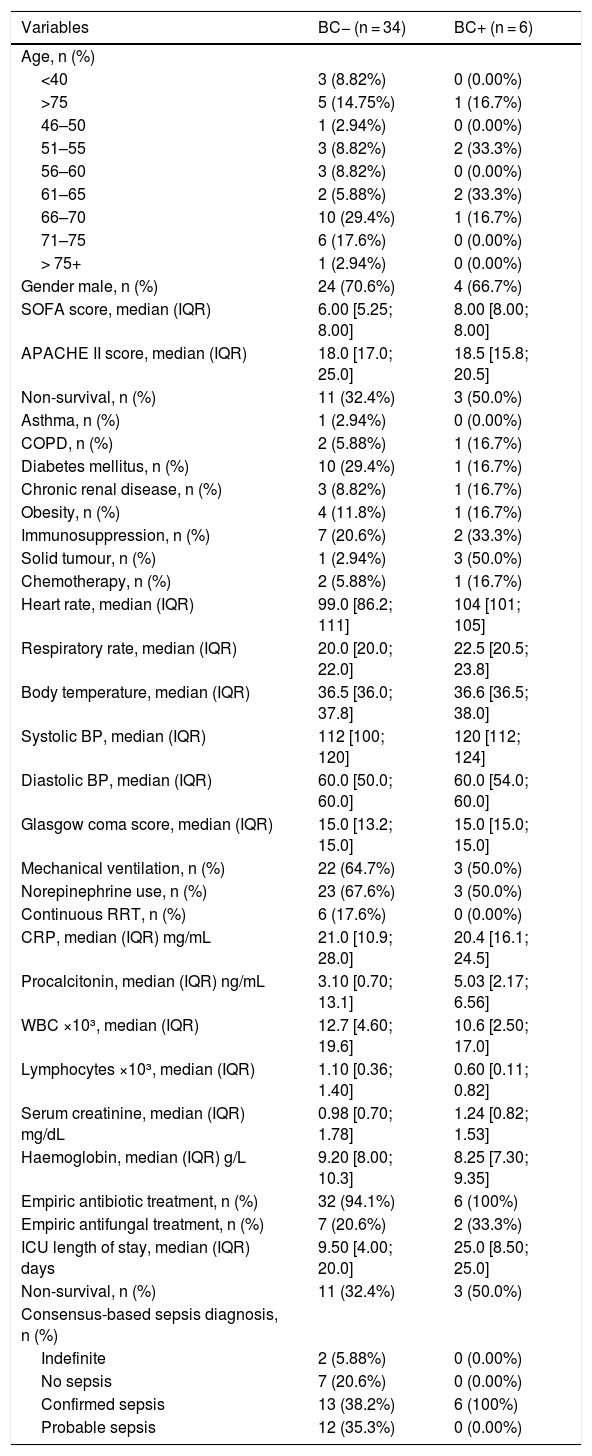
Recruitment proved more challenging than anticipated because of the stringent inclusion criteria. As a result, only 40 consecutive critically ill patients were prospectively included between June 2023 and December 2025 in a tertiary care, 24-bed mixed medical-surgical ICU, rather than the 120 patients originally planned,thereby limiting the statistical power of the study and the precision of diagnostic performance estimates. The median SOFA score was 6 (IQR 5–8) and the median APACHE II score was 18 (IQR 16–25), reflecting a genuinely high-acuity cohort. Baseline characteristics are presented for descriptive purposes only, highlighting the difficulty of early clinical discrimination between patients with subsequent positive and negative blood cultures (Table 1).
Baseline characteristics stratified by positive blood culture result (BC+).
| Variables | BC− (n = 34) | BC+ (n = 6) |
|---|---|---|
| Age, n (%) | ||
| <40 | 3 (8.82%) | 0 (0.00%) |
| >75 | 5 (14.75%) | 1 (16.7%) |
| 46–50 | 1 (2.94%) | 0 (0.00%) |
| 51–55 | 3 (8.82%) | 2 (33.3%) |
| 56–60 | 3 (8.82%) | 0 (0.00%) |
| 61–65 | 2 (5.88%) | 2 (33.3%) |
| 66–70 | 10 (29.4%) | 1 (16.7%) |
| 71–75 | 6 (17.6%) | 0 (0.00%) |
| > 75+ | 1 (2.94%) | 0 (0.00%) |
| Gender male, n (%) | 24 (70.6%) | 4 (66.7%) |
| SOFA score, median (IQR) | 6.00 [5.25; 8.00] | 8.00 [8.00; 8.00] |
| APACHE II score, median (IQR) | 18.0 [17.0; 25.0] | 18.5 [15.8; 20.5] |
| Non-survival, n (%) | 11 (32.4%) | 3 (50.0%) |
| Asthma, n (%) | 1 (2.94%) | 0 (0.00%) |
| COPD, n (%) | 2 (5.88%) | 1 (16.7%) |
| Diabetes mellitus, n (%) | 10 (29.4%) | 1 (16.7%) |
| Chronic renal disease, n (%) | 3 (8.82%) | 1 (16.7%) |
| Obesity, n (%) | 4 (11.8%) | 1 (16.7%) |
| Immunosuppression, n (%) | 7 (20.6%) | 2 (33.3%) |
| Solid tumour, n (%) | 1 (2.94%) | 3 (50.0%) |
| Chemotherapy, n (%) | 2 (5.88%) | 1 (16.7%) |
| Heart rate, median (IQR) | 99.0 [86.2; 111] | 104 [101; 105] |
| Respiratory rate, median (IQR) | 20.0 [20.0; 22.0] | 22.5 [20.5; 23.8] |
| Body temperature, median (IQR) | 36.5 [36.0; 37.8] | 36.6 [36.5; 38.0] |
| Systolic BP, median (IQR) | 112 [100; 120] | 120 [112; 124] |
| Diastolic BP, median (IQR) | 60.0 [50.0; 60.0] | 60.0 [54.0; 60.0] |
| Glasgow coma score, median (IQR) | 15.0 [13.2; 15.0] | 15.0 [15.0; 15.0] |
| Mechanical ventilation, n (%) | 22 (64.7%) | 3 (50.0%) |
| Norepinephrine use, n (%) | 23 (67.6%) | 3 (50.0%) |
| Continuous RRT, n (%) | 6 (17.6%) | 0 (0.00%) |
| CRP, median (IQR) mg/mL | 21.0 [10.9; 28.0] | 20.4 [16.1; 24.5] |
| Procalcitonin, median (IQR) ng/mL | 3.10 [0.70; 13.1] | 5.03 [2.17; 6.56] |
| WBC ×10³, median (IQR) | 12.7 [4.60; 19.6] | 10.6 [2.50; 17.0] |
| Lymphocytes ×10³, median (IQR) | 1.10 [0.36; 1.40] | 0.60 [0.11; 0.82] |
| Serum creatinine, median (IQR) mg/dL | 0.98 [0.70; 1.78] | 1.24 [0.82; 1.53] |
| Haemoglobin, median (IQR) g/L | 9.20 [8.00; 10.3] | 8.25 [7.30; 9.35] |
| Empiric antibiotic treatment, n (%) | 32 (94.1%) | 6 (100%) |
| Empiric antifungal treatment, n (%) | 7 (20.6%) | 2 (33.3%) |
| ICU length of stay, median (IQR) days | 9.50 [4.00; 20.0] | 25.0 [8.50; 25.0] |
| Non-survival, n (%) | 11 (32.4%) | 3 (50.0%) |
| Consensus-based sepsis diagnosis, n (%) | ||
| Indefinite | 2 (5.88%) | 0 (0.00%) |
| No sepsis | 7 (20.6%) | 0 (0.00%) |
| Confirmed sepsis | 13 (38.2%) | 6 (100%) |
| Probable sepsis | 12 (35.3%) | 0 (0.00%) |
BC = blood culture; BP = blood pressure; CRP = C-reactive protein; IQR = interquartile range; RRT = renal replacement therapy; WBC = white blood cells.
*P < .05.
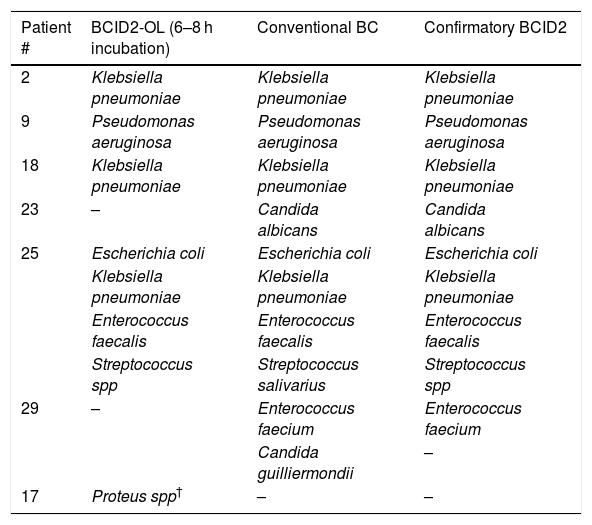
The median time from blood culture sampling to the start of incubation was 20 min (IQR 15–36). Six patients (15%) developed confirmed bacteraemia or fungaemia (The source of infection was respiratory in four patients and intra-abdominal in two). Microorganism identification is detailed in Table 2. BCID2-OL correctly identified the causative pathogen in all bacteraemic episodes except two: Patient #23, in whom Candida albicans was not detected and Patient #29, who had a polymicrobial episode involving Enterococcus faecium and Candida guilliermondii, a species not included in the syndromic panel. It should be noted that Candida species generally exhibit slower growth kinetics in blood cultures than bacterial pathogens. This is particularly relevant for non-albicans Candida species8 and may also be influenced by the type of blood culture bottle used.9 Consequently, the lower sensitivity observed for fungal pathogens in the present study is not unexpected.
Pathogen identification by off-label BCID2 (BCID2-OL), conventional blood culture(BC), and confirmatory BCID2 after culture positivity.
| Patient # | BCID2-OL (6–8 h incubation) | Conventional BC | Confirmatory BCID2 |
|---|---|---|---|
| 2 | Klebsiella pneumoniae | Klebsiella pneumoniae | Klebsiella pneumoniae |
| 9 | Pseudomonas aeruginosa | Pseudomonas aeruginosa | Pseudomonas aeruginosa |
| 18 | Klebsiella pneumoniae | Klebsiella pneumoniae | Klebsiella pneumoniae |
| 23 | – | Candida albicans | Candida albicans |
| 25 | Escherichia coli | Escherichia coli | Escherichia coli |
| Klebsiella pneumoniae | Klebsiella pneumoniae | Klebsiella pneumoniae | |
| Enterococcus faecalis | Enterococcus faecalis | Enterococcus faecalis | |
| Streptococcus spp | Streptococcus salivarius | Streptococcus spp | |
| 29 | – | Enterococcus faecium | Enterococcus faecium |
| Candida guilliermondii | – | ||
| 17 | Proteus spp† | – | – |
BCID2-OL = off-label BCID2 performed at 6–8 h of incubation, prior to conventional positivity. – = not detected. C. guilliermondii is not included in the BCID2 panel.
Of the 10 microorganisms identified by conventional BC, 7 were detected by BCID2-OL (overall yield, 70%); when only panel-covered organisms were considered, the diagnostic yield reached 78% (7 of 9). Notably, in Patient #17, BCID2-OL detected Proteus spp., which was not recovered by conventional blood culture. Although identification of the microorganism did not prompt any modification of antimicrobial therapy, as the patient was already receiving appropriate empirical carbapenem treatment, this finding suggests that the molecular approach may retain diagnostic sensitivity despite ongoing antimicrobial exposure. All microorganisms covered by the syndromic panel were subsequently confirmed by standard BCID2 testing following culture positivity. Importantly, our findings suggest that a negative BCID2-OL result obtained after 6–8 h of incubation should not be used to withhold, de-escalate, or discontinue empirical antimicrobial therapy in patients with suspected sepsis or a high risk of bloodstream infection.
The median time from incubation to pathogen identification using BCID2-OL was 7 h (IQR 6.1–7.2), compared with 19.8 h (IQR 7.1–32.3) for conventional BC. This represents an anticipated diagnosis of at least 12 h relative to the standard workflow. Although not designed to assess clinical effectiveness, antimicrobial therapy was modified in 4 of 5 cases with actionable early BCID2 results (80%), including early escalation in 2 (40%). The clinical significance of achieving appropriate therapy earlier is well established; recent propensity score-matched data from ICU patients with bloodstream infections have shown that BCID2-guided stewardship reduced day-28 mortality from 77.1% to 27.8% compared with standard microbiological workflows.10
To our knowledge, this is the first prospective study to evaluate the systematic application of the BCID2 panel in an off-label, pre-positivity strategy on BC in a consecutive ICU population. The approach is technically feasible, requires no additional equipment beyond the standard BIOFIRE® platform, and yields clinically actionable results approximately 12 h ahead of conventional methods. Implementation of rapid molecular diagnostics integrated within active antimicrobial stewardship programmes has been consistently associated with improved prescribing appropriateness and patient outcomes.11,12 The present data support the hypothesis that applying this strategy even earlier, before conventional positivity, may further extend this benefit to a critical diagnostic window in which no molecular information is currently available.
Certain limitations of this pilot study must be acknowledged. The sample size and the low bacteraemia rate (15%) inherent to an unselected ICU cohort restrict the precision of diagnostic yield estimates. The absence of a control arm precludes causal inference regarding clinical outcomes. Performance was suboptimal for Candida spp., and off-label use has not been formally validated analytically across the full microbial spectrum at pre-positivity bacterial loads.
In conclusion, this pilot study demonstrates that BCID2-OL testing performed 6−8 h after the initiation of blood culture incubation is technically feasible and can identify pathogens approximately 12 h earlier than conventional microbiological methods. Nevertheless, these findings should be considered hypothesis-generating. The clinical impact, diagnostic performance, and cost-effectiveness of this strategy require confirmation in larger prospective studies with sufficient statistical power before routine implementation can be recommended.
Authors’ contributionsConceptualisation: LC, AR, FGB, ASS; Formulation of the analysis: LC, AR, ST; Funding acquisition: AR; Research: LC, ST, AR, FGB, MB, ASS; Methodology: LC, AR, MB; Drafting (Original draft): LC, AR, ST, FGB; Drafting (revision and editing): MB, ASS, AR, LC. All authors have read and approved the final version of the manuscript.
EthicsCEIM Ref. 182/2022. Informed consent waived.
ClinicalTrials.gov: NCT05833412.
Declaration of Generative AI and AI-assisted technologies in the writing processChatGPT was only used for English proofreading.
FundingFunded by: International Research Grant bioMérieux (AR).
AR has received speaking fees from PFIZER, BIOMERIEUX, GILEAD and MUNDIPHARMA.
All other authors declare that they have no conflicts of interest to disclose.
We would like to thank all the researchers listed here who were part of the MESIS Working Group: PAREJO VICO, Susana; TORRES TREVEJO, Patricia;DUQUE CORTES, Elisabet; ORMEÑO COLLADO, Cristian; FIGAROLA CERVERA, Roser; CODORNIU CODORNIU, Adria; TRUJILLO CASTELLANOS, Judit; MOSINEGUTU, Andreea Sarah; POZO FERRANDO, Aleidis; SALAMANCA CUADRADO, M. Encarnacion; VALLDEPEREZ GOMIS, Paula; GINES PUIGVERT, Joel; CARDONA GARCIA, Luisa Fernanda; GALINDO LARIOS, Andrea; FERNANDEZ SANZ, Carlos; PICON SANCHEZ, Rebeca; STRUGARIU CIOBANU, Georgiana; GIMENEZ GARCIA, Alba.