
Suggestions
Idioma
Guide for authors
Searcher
Journal Information
Vol. 50. Issue 10.
(October 2026)
Cite
Cite
Share
Download PDF
More article options
Visits
194
Vol. 50. Issue 10.
(October 2026)
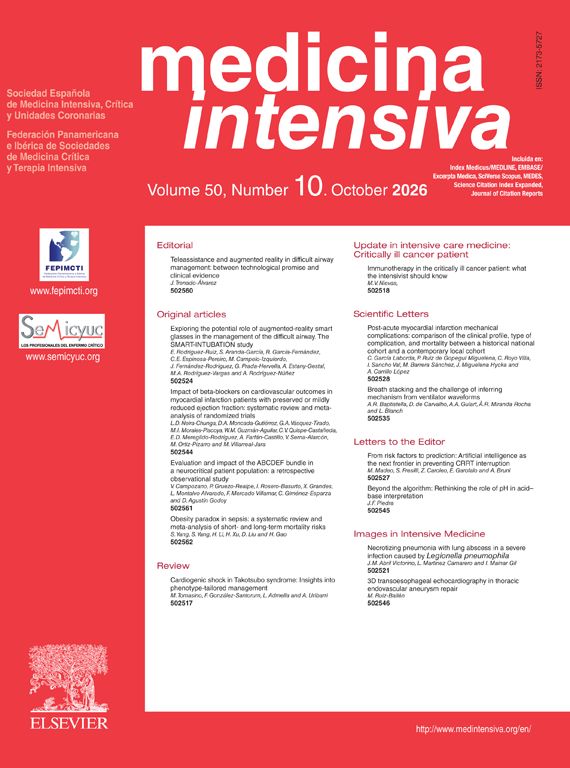
Update In intensive care medicine: Critical cancer patients

Immunotherapy in the critically ill cancer patient: What the intensivist should know

Inmunoterapia en el paciente crítico con cáncer: lo que el intensivista debe conocer
Visits
194
María Verónica Nievasa,b,c,
Corresponding author
mnievas@santpau.cat

Corresponding author.
, Alejandra García-Rochec,d,e, Maricela Jiménez-Lópezf,g, Cándido Díaz-Lagaresc,d,e
a Servicio de Medicina Intensiva, Hospital de la Santa Creu i Sant Pau Barcelona, Barcelona, Spain
b Institut de Recerca Sant Pau - Centre CERCA, Barcelona, Spain
c Universitat Autonòma Barcelona, Barcelona, Spain
d Servicio de Medicina Intensiva, Vall d'Hebron Hospital Universitari, Vall d'Hebron Hospital Campus, Barcelona, Spain
e Grupo de Investigación SODIR, Instituto de Vall d'Hebron (VHIR), Barcelona, Spain
f Unidad de Medicina Intensiva, Hospital de Tortosa Verge de la Cinta, Institut Català de la Salut, Tortosa, Tarragona, Spain
g Institut d'Investigació Sanitària Pere Virgili (IISPV), Tarragona, Spain
This item has received
Article information
Abstract
Full Text
Bibliography
Download PDF
Statistics
Abstract

Immunotherapy has produced a revolution in the treatment of cancer. It involves manipulating the patient's immune system to identify and destroy malignant cells. There has been an explosion in the development of these therapies in recent decades, with the emergence of monoclonal and bispecific antibodies, immune checkpoint inhibitors, and cellular therapies, including T cells modified with a chimeric antigen receptor (CAR-T cells) and tumor-infiltrating lymphocytes (TILs). While these new therapies offer new hope to patients, they have also introduced a new profile of adverse effects, resulting from the action of a hyperactive immune system, such as infusion reactions, autoimmune phenomena, cytokine release syndrome, and neurotoxicity associated with immune effector therapies, as well as capillary leak syndrome.

Keywords:
Immunotherapy
Critically ill hematological cancer patient
Monoclonal antibodies
Immune checkpoint inhibitors
CAR-T
TIL
Allogeneic transplantation
Cytokine release syndrome
Immunotherapy-associated neurotoxicity
Resumen

La inmunoterapia ha supuesto una revolución en el tratamiento de las neoplasias. Su acción se fundamenta en la manipulación del sistema inmune del paciente para identificar y destruir las células malignas. En las últimas décadas hemos asistido a una explosión en el desarrollo de estas terapias, con la aparición de anticuerpos monoclonales y biespecíficos, inhibidores de los puntos de control inmunitario y terapias celulares, incluyendo las células T modificadas con un receptor antigénico quimérico (CAR-T) y los linfocitos infiltrantes de tumor (TILs). Estas nuevas terapias han supuesto nuevas esperanzas para los pacientes, pero también han traído un nuevo perfil de efectos adversos, derivados de la acción de un sistema inmune hiperactivo, como reaccciones infusionales, fenómenos autoinmunes, síndrome de liberación de citoquinas y la neurotoxidad associada a terapias inmunoefectoras, y el síndrome de fuga capilar.

Palabras clave:
Inmunoterapia
Paciente oncohematológico crítico
Anticuerpos monoclonales
Inhibidores punto de control inmunitario
CAR-T
TILs
Trasplante alogénico
Síndrome de liberación de citoquinas
Neurotoxicidad asociada a inmunoterapia

Article

These are the options to access the full texts of the publication Medicina Intensiva (English Edition)
Member
If you are a member of the Sociedad Española de Medicina Intensiva, Crítica y Unidades Coronarias::
Go to the members area of the website of the SEMICYUC (www.semicyuc.org )and click the link to the magazine.

Subscriber
Subscriber

If you already have your login data, please click here .

If you have forgotten your password you can you can recover it by clicking here and selecting the option “I have forgotten my password”
Subscribe
Subscribe to
Medicina Intensiva (English Edition)
Purchase
Purchase article

Purchasing article the PDF version will be downloaded

Purchase now
Contact
Phone for subscriptions and reporting of errors
From Monday to Friday from 9 a.m. to 6 p.m. (GMT + 1) except for the months of July and August which will be from 9 a.m. to 3 p.m.
Calls from Spain
932 415 960
Calls from outside Spain
+34 932 415 960
Email
Idiomas
Medicina Intensiva (English Edition)
Article options
Tools
Supplemental materials