The original article entitled: «Determinants in the decision of intensive care admission of cancer patients»1 has recently been published in the journal Medicina Intensiva. This prospective, multicenter study conducted in 33 Spanish Intensive Care Units (ICUs) analyzed the clinical, functional, and oncological factors that influenced the decision to admit cancer patients to the ICU, as well as the development of specific predictive models for solid and hematological tumors. A subanalysis was conducted using a well-characterized cohort with the objective of broadening understanding of the profile and evolution of critical cancer patients within the context of our setting.
In the present work, a secondary analysis of the aforementioned population is presented, with the focus being exclusively on patients who were admitted to the ICU. The objective of this substudy was to compare the characteristics, causes of admission, severity, and evolution of patients with previous oncological treatment versus those without previous treatment. The latter group included patients in whom the diagnosis of cancer was recent or in whom the clinical onset of the disease made admission to the ICU necessary. The starting hypothesis was that both groups would present significant differences both in their clinical and functional profile and in their short- and medium-term outcomes. This could have direct implications for candidate selection and prognostic stratification in the ICU.
The variables analyzed were identical to those collected in the original study,1 including demographic data, tumor type and stage, previous treatments, comorbidities, functional scales (Eastern Cooperative Oncology Group [ECOG] and Karnofsky), severity scales (Acute Physiology and Chronic Health Disease Classification System II [APACHE II] and the Sequential Organ Failure Assessment [SOFA]), as well as the main reasons for admission and clinical outcomes (in-ICU, in-hospital and 3-month mortality, and degree of frailty after discharge).
Qualitative variables were described as absolute and relative frequencies (%), while quantitative variables were expressed as the mean and standard deviation (SD) or median and interquartile range, depending on their distribution. The normality of continuous variables was assessed using a variety of analytical methods, including normality tests and graphical analysis. The utilization of parametric or non-parametric tests was contingent upon on the distribution of the data. The Student t-test was employed for continuous variables with a normal distribution, while the Mann-Whitney U test was utilized for those variables that did not conform to a normal distribution. Categorical variables were compared using the chi-square test or Fisher's exact test, contingent upon the anticipated frequency of the categories. Statistical significance was considered for P < .05.
To evaluate the association between previous oncological interventions and the primary clinical and outcome variables, a series of multivariate logistic regression models were implemented, with adjustments made for factors such as age, sex, and baseline functional status (ECOG and Karnofsky index), given their possible implications as confounding factors. All statistical analyses were performed using the STATA 18/SE® package (StataCorp, College Station, TX, USA).
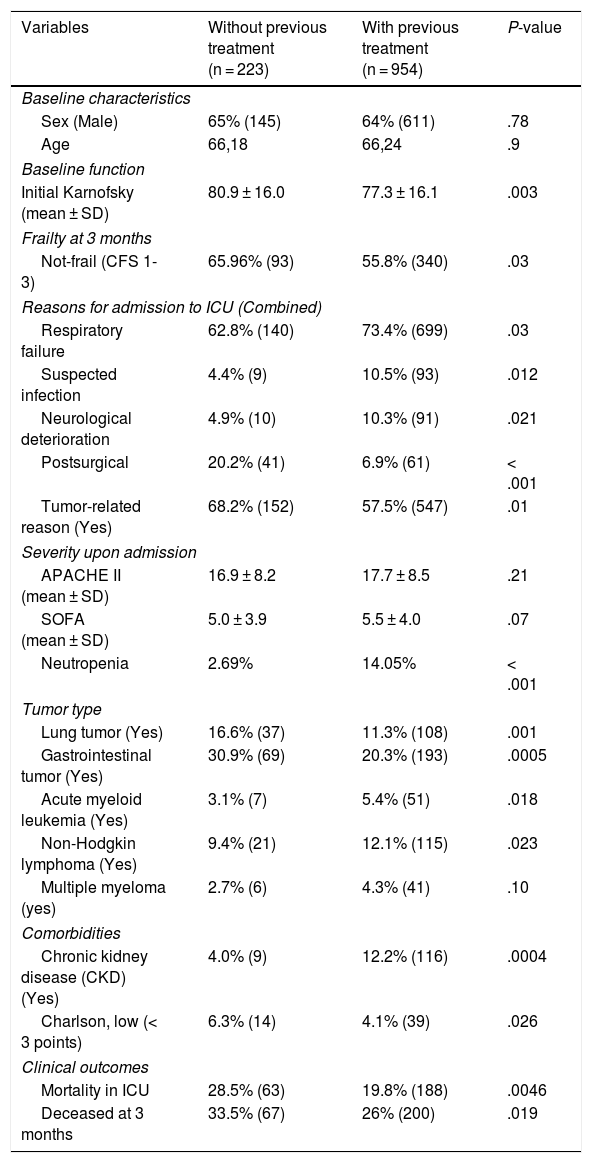
A total of 1177 cancer patients admitted to the ICU were included, of whom 954 (81%) had received previous treatment (chemotherapy, radiotherapy, or surgery) and 223 (19%) had not yet received treatment due to a recent or de novo diagnosis. Table 1 presents an overview of the patient characteristics according to the treatment received.
Characteristics of the patients with and without previous treatment and degree of significance.
| Variables | Without previous treatment (n = 223) | With previous treatment (n = 954) | P-value |
|---|---|---|---|
| Baseline characteristics | |||
| Sex (Male) | 65% (145) | 64% (611) | .78 |
| Age | 66,18 | 66,24 | .9 |
| Baseline function | |||
| Initial Karnofsky (mean ± SD) | 80.9 ± 16.0 | 77.3 ± 16.1 | .003 |
| Frailty at 3 months | |||
| Not-frail (CFS 1-3) | 65.96% (93) | 55.8% (340) | .03 |
| Reasons for admission to ICU (Combined) | |||
| Respiratory failure | 62.8% (140) | 73.4% (699) | .03 |
| Suspected infection | 4.4% (9) | 10.5% (93) | .012 |
| Neurological deterioration | 4.9% (10) | 10.3% (91) | .021 |
| Postsurgical | 20.2% (41) | 6.9% (61) | < .001 |
| Tumor-related reason (Yes) | 68.2% (152) | 57.5% (547) | .01 |
| Severity upon admission | |||
| APACHE II (mean ± SD) | 16.9 ± 8.2 | 17.7 ± 8.5 | .21 |
| SOFA (mean ± SD) | 5.0 ± 3.9 | 5.5 ± 4.0 | .07 |
| Neutropenia | 2.69% | 14.05% | < .001 |
| Tumor type | |||
| Lung tumor (Yes) | 16.6% (37) | 11.3% (108) | .001 |
| Gastrointestinal tumor (Yes) | 30.9% (69) | 20.3% (193) | .0005 |
| Acute myeloid leukemia (Yes) | 3.1% (7) | 5.4% (51) | .018 |
| Non-Hodgkin lymphoma (Yes) | 9.4% (21) | 12.1% (115) | .023 |
| Multiple myeloma (yes) | 2.7% (6) | 4.3% (41) | .10 |
| Comorbidities | |||
| Chronic kidney disease (CKD) (Yes) | 4.0% (9) | 12.2% (116) | .0004 |
| Charlson, low (< 3 points) | 6.3% (14) | 4.1% (39) | .026 |
| Clinical outcomes | |||
| Mortality in ICU | 28.5% (63) | 19.8% (188) | .0046 |
| Deceased at 3 months | 33.5% (67) | 26% (200) | .019 |
ECOG: Eastern Cooperative Oncology Group; CFS: Clinical Frailty Scale; ICU: Intensive Care Unit; APACHE II: Acute Physiology and Chronic Health Disease Classification System II; SOFA: Sequential Organ Failure Assessment.
Patients who had not received previous treatment exhibited superior baseline functional status, as evidenced by a mean Karnofsky index of 80.9 ± 16.0, in contrast to 77.3 ± 16.1 in patients who had undergone previous treatment (P = .003). The percentage of independent patients (Karnofsky ≥ 80) was also higher in the patients without previous treatment (73.3% versus 64.2%; P = .026). In accordance with the above, the prevalence of frailty at 3 months was lower in this group, with a greater proportion of patients categorized as “non-frail” (Clinical Frailty Scale [CFS] 1–3: 65.9% versus 55.8%; P = .03).
Regarding the reason for admission, there were notable differences between the groups. Patients who had previously received treatment were admitted more frequently due to acute respiratory failure (73.4% versus 62.8%; P = .03), suspected infection (10.5% versus 4.4%; P = .012), and neurological deterioration (10.3% versus 4.9%; P = .021). In contrast, patients without previous treatment were admitted more frequently due to reasons directly related to the tumor (68.2% versus 57.5%; P = .01). In terms of severity, the APACHE II (16.9 versus 17.7; P = .21) and SOFA scores (5.0 versus 5.5; P = .07) were statistically similar, suggesting that the observed differences in mortality are not explained by greater baseline physiological severity.
The tumor profile was also different. Patients without previous treatment exhibited a higher proportion of solid tumors, particularly lung (16.6% versus 11.3%; P = .001) and gastrointestinal malignancies (30.9% versus 20.3%; P = .0005). In contrast, patients with previous treatment exhibited a higher prevalence of hematological malignancies, including acute myeloid leukemia (5.4% versus 3.1%; P = .018) and non-Hodgkin lymphoma (12.1% versus 9.4%; P = .023).
With respect to the presence of comorbidities, a lower prevalence of chronic kidney disease was observed in patients who had not received previous treatment (4.0% versus 12.2%; P = .0004), as well as a slight predominance of low comorbidity burden (Charlson score < 3: 6.3% versus 4.1%; P = .026).
The clinical results showed a relevant finding: despite their better baseline condition, the patients without previous treatment exhibited higher early mortality. The in-ICU mortality rate was found to be 28.5%, which is significantly higher than the 19.8% observed in patients who had received previous treatment (P = .0046). At three months, the mortality rate was found to be greater among patients who had not received any treatment (33.5% versus 26.5%; P = .019). However, among the survivors, the group without previous treatment exhibited superior functional recovery, with a higher proportion of patients classified as “non-frail” at three months (CFS 1-3: 65.9% versus 55.8%).
These results demonstrate that the previous clinical and oncological context of the patient significantly modulates the prognosis of critically ill cancer patients.2,3 Patients with previous treatment represent a subgroup with a high proportion of admissions due to acute medical conditions, primarily of an infectious or respiratory nature. In contrast, patients who have not received previous treatment, despite exhibiting superior functional status and a lower prevalence of comorbidities, demonstrate higher early mortality rates. This phenomenon is likely associated with tumor biology, the clinical onset of the disease, or the need for urgent procedures, all of which are not fully captured by conventional severity indices.
Overall, the present subanalysis demonstrates the existence of clinical and evolutive differences between critical cancer patients according to the time of the oncological process. This finding suggests that this factor could be considered, along with functional status and physiological severity, in the comprehensive assessment of such patients.4,5 The systematic integration of the therapeutic context into prognostic models may enhance the discriminatory capacity of the existing scales. These findings complement the results of the original multicenter study1 and provide more detailed insight into the heterogeneity of the cancer patients admitted to the ICU. The present subanalysis has the limitations inherent to its design, including possible selection bias and variability between centers.
Participating centersDepartment of Intensive Care Medicine, Complexo Hospitalario Universitario de Ourense (Ourense); Área de Vigilancia Intensiva, Hospital Clínic (Barcelona); Hospital Universitario Vall d'Hebron (Barcelona); Hospital General Universitario de Castellón (Castellón); Hospital Universitario de Burgos (Burgos); Hospital Universitario La Paz (Madrid); Hospital Clínico Universitario Lozano Blesa (Zaragoza); Hospital Universitario del Sureste (Madrid); Hospital Clínico Universitario Virgen de la Arrixaca (Murcia); Hospital General Universitario de Ciudad Real (Ciudad Real); Hospital Universitario Lucus Augusti (Lugo); Hospital Universitario de Álava (Vitoria-Gasteiz); Hospital Universitario Infanta Leonor (Madrid); Hospital General Universitario de Toledo (Toledo); Hospital General Universitario de Jaén (Jaén); Hospital Universitario de Getafe (Madrid); Hospital Universitario de Jerez (Cádiz); Complexo Hospitalario Universitario de Vigo (CHUVI), SERGAS; Instituto de Investigación Sanitaria Galicia Sur (IIS Galicia Sur), Vigo (Pontevedra); Hospital Universitario de Cruces (Barakaldo, Vizcaya); Hospital Clínico Universitario de Salamanca (Salamanca).
CRediT authorship contribution statementJuan Higuera Lucas and Elena Cuenca Fito contributed to the writing of the manuscript. Inés Gómez Acebo performed the statistical analysis. Cándido Díaz-Lagares, Marta Malingre, and María Victoria Boado Varela participated in the critical review of the document. All authors collaborated in data collection. Elena Cuenca Fito conducted and designed the initial study.
The conflicts of interest of the authors are reflected in the corresponding conflicts of interest statement pages. It is also reported that artificial intelligence tools have been used exclusively to enhance the linguistic quality and wording of the text, without the involvement of these tools in the analysis of data, interpretation of results, or scientific elaboration of the content.
Eric Mayor-Vázquez, Bárbara Vidal Tegedor, Noelia Isabel Lázaro Martín, Alba López Fernández, Laura Sánchez Montori, Íñigo Isern, Amparo Cabanillas Carrillo, Jorge Sánchez Gómez, María Luisa Gómez Grande, Alba Fernández Rodríguez, Anastasio Espejo, Domingo Díaz Díaz, Alejandra García Roche, Margarita Márquez, Mireya Molina Cortés, Natalia Valero, Manuel Gracia Romero, Fernando Eiras Abalde, Noelia Albalá Martínez, María del Mar Jiménez Quintana, Alberto Orejas Gallego, Rosa María de la Casa, Diana Monge Donaire, Amanda Lesmes González de Aledo, Ariadna Bellès Casas, Lucía Larrañaga Sigwald, Sandra Portillo Sánchez, Alfredo Bardal Ruiz, Inés Lipperheide, Jimena Luján Vargas, Paula Recena Pérez.