
Gastrointestinal dysfunction in critically ill patients is frequent yet poorly standardized in daily practice, and its evaluation and management have largely been restricted to nursing protocols.1,2 Constipation and diarrhea are associated with prolonged ICU stay, nutritional intolerance, infectious complications, and increased mortality,3–5 but their assessment is often inconsistent and based on subjective descriptions. Despite its widespread use in the general population, the Bristol Stool Form Scale (BSFS)6,7 has important limitations in the ICU, where patients are frequently sedated, immobile, and dependent on diapers, making stool form difficult to characterize and interobserver agreement suboptimal. This limitation hinders the implementation of protocols aimed at regulating bowel habits and leads to inconsistencies between physicians and nursing staff. In this context, the objective of the present study was to develop and validate a specific scale for the assessment of bowel habits in adult ICU patients.
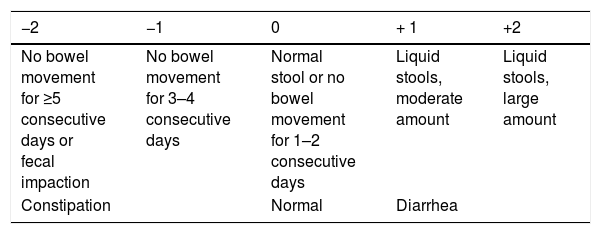
Accordingly, we developed and evaluated a simple bowel habit scale specifically designed for adult ICU patients in three phases: scale development, assessment of face and content validity, and evaluation of inter-rater reliability and construct validity. The ICU Bowel Habit Scale is a five-category observational instrument ranging from fecal impaction (−2) to profuse diarrhea (+2), with normal bowel habit as the central category (0), as shown in Table 1. The scale was designed for routine application by nursing staff and integrates both stool frequency and quantity, particularly in patients receiving enteral nutrition.
ICU Bowel Habit Scale.
| −2 | −1 | 0 | + 1 | +2 |
|---|---|---|---|---|
| No bowel movement for ≥5 consecutive days or fecal impaction | No bowel movement for 3–4 consecutive days | Normal stool or no bowel movement for 1–2 consecutive days | Liquid stools, moderate amount | Liquid stools, large amount |
| Constipation | Normal | Diarrhea | ||
This table summarizes the five-category ICU stool scale, ranging from severe constipation or fecal impaction (−2) to profuse diarrhea (+2), with normal bowel function at the midpoint (0). The scale is designed for practical use by nursing staff, facilitating consistent and objective assessment of bowel habits in critically ill patients.
The scale was developed through iterative refinement based on direct clinical observation and structured feedback from ICU nurses and physicians. Face and content validity were assessed using a Delphi process with intensivists and head nurses, complemented by cognitive interviews with experienced nurse assistants, analyzed using open coding based on Grounded Theory until data saturation was achieved.8 Quantitative content validity was confirmed by expert ratings evaluating clarity, relevance, and sufficiency of each response option, all of which were rated as highly relevant. After standardized training, inter-rater reliability and discriminant validity were evaluated in adult ICU patients, with statistical methods and sample size justification detailed in the Supplementary material (Appendix B).
To evaluate reliability and discriminant validity, the scale was applied to a cohort of 189 adult ICU patients admitted to a high-complexity university hospital. Patients with ostomies, inability to receive enteral nutrition, or ICU stays shorter than three days were excluded. Three independent nurse assistants assessed bowel habits using the scale, with supervision to ensure protocol adherence. For construct validation, an intensivist blinded to the scale results classified patients as having constipation, normal bowel habits, or diarrhea based on routine clinical documentation.
The median age of the cohort was 56 years (range 16–88), with a median APACHE II score of 17 (range 0–46), and 61.3% of patients were male. According to the ICU Bowel Habit Scale, constipation was identified in 39.2% of patients, normal bowel habits in 39.2%, and diarrhea in 21.7%, proportions consistent with previous reports in critically ill populations. Age and severity scores were comparable across bowel habit groups, with no significant differences observed. Inter-rater agreement was excellent, with a concordance of 98.5% and an intraclass correlation coefficient of 0.91 (95% CI, 0.89–0.93), indicating high reproducibility among nursing observers.
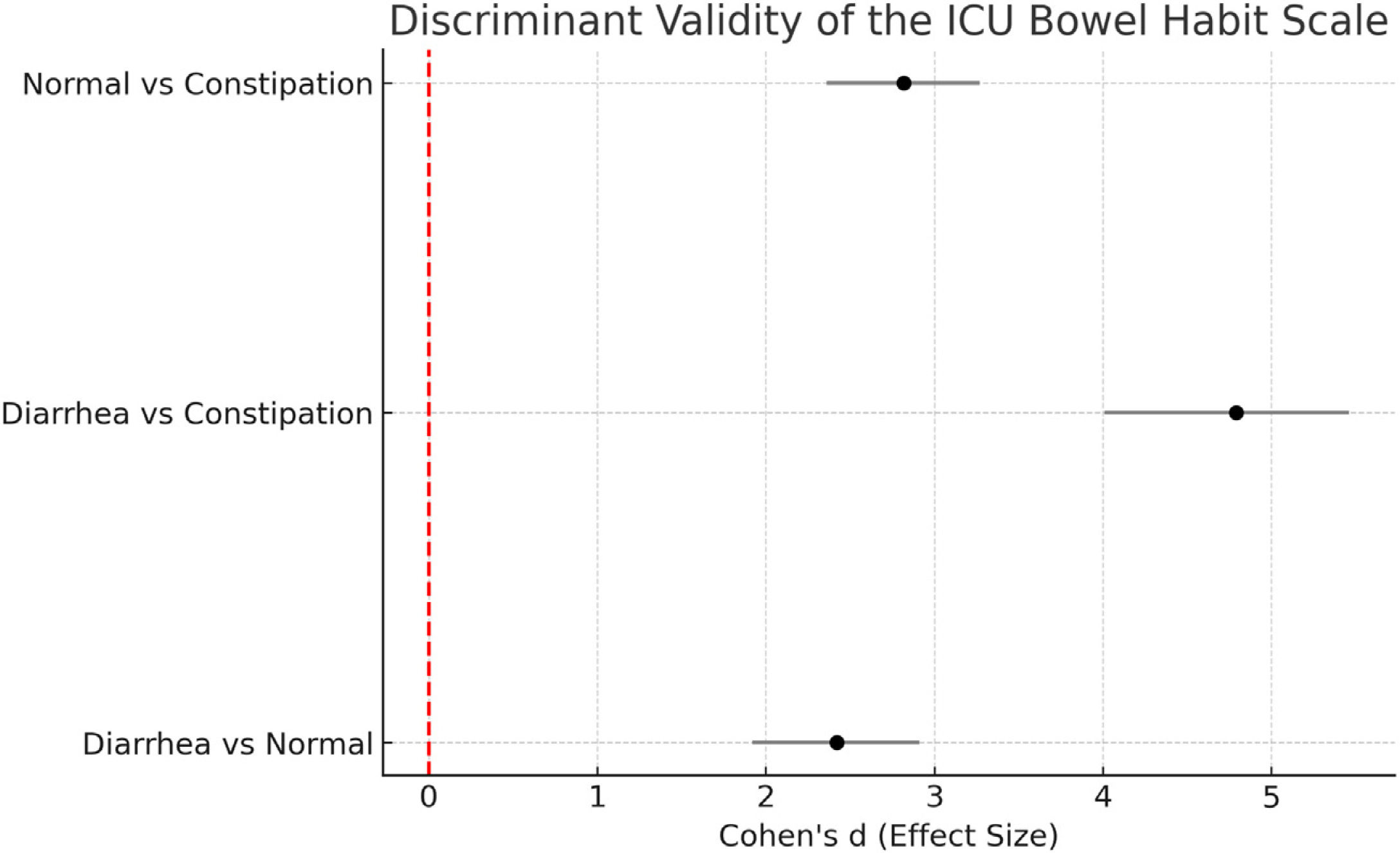
Discriminant validity was demonstrated by clear separation of scale scores among the three clinical groups. Mean scores were −1.38 (SD 0.59) for constipation, 0.12 (SD 0.47) for normal bowel habits, and 1.29 (SD 0.51) for diarrhea, with large effect sizes in all pairwise comparisons (Cohen’s d >2). As illustrated in Fig. 1, these findings confirm that the scale effectively distinguishes clinically meaningful bowel habit patterns in ICU patients, reinforcing its value as a sensitive and clinically relevant measure of gastrointestinal function.
Discriminant validity of the ICU Bowel Habit Scale.
Effect sizes (Cohen’s d) demonstrated strong discrimination between bowel habit categories: diarrhea vs. normal (d = 2.42; 95% CI, 1.92–2.91), diarrhea vs. constipation (d = 4.79; 95% CI, 4.01–5.46), and normal vs. constipation (d = 2.82; 95% CI, 2.36–3.27). These results support the scale’s discriminant validity in ICU patients.
The novelty of this instrument lies in its ICU-specific design and practical applicability. In this prospective validation study, the ICU Bowel Habit Scale showed excellent inter-rater reliability and clear discriminant validity among constipation, normal bowel habits, and diarrhea. In this context, this instrument may facilitate consistent assessment and communication between healthcare professionals regarding bowel function in critical care settings. Unlike existing tools developed for ambulatory or enterally fed populations, the ICU Bowel Habit Scale addresses clinically relevant scenarios in critical care, including prolonged absence of bowel movements, fecal impaction, and quantitative assessment of liquid stools. While the BSFS, widely used in general practice, shows reduced agreement when categorizing constipation, normal bowel habits, and diarrhea in critically ill patients,6,7 our scale demonstrated excellent inter-rater reliability and clear discriminant validity. Other instruments have focused on enterally fed patients9 or pediatric populations,10 limiting their applicability to adult ICUs. Overall, the simplicity of the ICU Bowel Habit Scale facilitates routine use by nursing staff, promotes a shared language between nurses and physicians, and supports a more standardized and consistent assessment and communication regarding bowel function in daily critical care practice.
This study has limitations, including its single-center design and the lack of systematic evaluation of therapeutic variables such as opioid use, enteral nutrition, or prokinetics, which may influence bowel habits. In addition, the impact of scale-guided interventions on clinical outcomes was not assessed. However, its strengths include prospective data collection, multiple independent observers, and robust reliability and validity analyses. Further studies are needed to explore associations with clinically relevant outcomes, such as ICU length of stay, infections, nutritional tolerance, and to determine the impact of the scale on clinical decision-making and patient outcomes.
In conclusion, the ICU Bowel Habit Scale is the first validated instrument specifically developed for adult critically ill patients. It demonstrates high inter-rater reliability and strong discriminant validity, supporting its use as a standardized tool for bowel habit assessment in the ICU. Its implementation may improve recognition of gastrointestinal dysfunction and provide a foundation for future interventional studies in critical care.
CRediT authorship contribution statementCarlos Carvajal MD: Conceptualization, Data Curation, Data Collection, Methodology, Investigation, Supervision, Writing - Original Draft, Writing - review & editing.
Carlos Yepes MD, MSc, PhD: Formal Analysis, Methodology, Writing - Review & Editing.
Jenny García MD, PhD: Conceptualization, Formal analysis, Methodology, Software, Writing – review & editing.
Fabián Muñoz, MD: Investigation, Data Collection, Writing - Review & Editing.
Juan M. Arias MD: Investigation, Data Collection, Methodology, Writing - Review & Editing.
Jairo González, MD: Investigation, Data Collection, Writing - Review & Editing.
Ethical approvalAll authors and collaborators have disclosed any potential financial or ethical conflicts of interest related to the study. Authorship inclusion and order were determined at the time of initial submission. Any changes in authorship during revisions will be justified by the corresponding author and approved by all authors.
Declaration of Generative AI and AI-assisted technologies in the writing processNo artificial intelligence tools were used for the generation of content in this manuscript. Any use of AI in future submissions will be fully disclosed in the Methods section, in accordance with journal policy. Authors collectively assume full responsibility for all content, including verification of any AI-assisted material, to ensure scientific integrity.
Financial supportThis study was supported by departmental research funds from the Department of Critical Care and Intensive Medicine, Pablo Tobón Uribe Hospital.
All authors declare no conflicts of interest related to this study.
All authors of this manuscript meet the criteria for authorship as defined by the International Committee of Medical Journal Editors (ICMJE) and have contributed substantially to the conception, design, data acquisition, analysis, and interpretation of the study, as well as drafting and revising the manuscript. The corresponding author, Carlos A. Carvajal MD, has verified that all individuals listed as authors accept responsibility for the entire content of the submission.
The authors would like to express their sincere gratitude to Martha Sánchez, MD; Juan Carlos Torres, MD; Nelson Giraldo, MD, MSc; and Gisela de la Rosa, MD, for their valuable contributions and support to this work.
The following are Supplementary data to this article: