


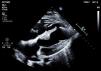
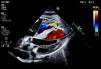
A 73-year-old diabetic patient was admitted to the ICU after an evolved infarction due to the occlusion of a recently percutaneously revascularized anterior descending artery. In the ICU he presented hemodynamic instability, and echocardiography was performed (Figs. 1 and 2). Emergent surgery to correct the ventricular septal defect was decided, and the patient was finally placed on V-A ECMO due to cardiogenic shock SCAI-E. This complication has decreased from 2% to 0.2% since the era of fibrinolysis, but mortality remains high (50–100%) in patients requiring emergent surgery. The series in which patients underwent late surgery 2–3 weeks later report lower mortality (8%); this actually reflects patient self-selection, as those who can be stabilized with medical treatment during this time have a greater chance of survival. Management is multidisciplinary: medical, surgical, and with percutaneous closure.
Declaration of Generative AI and AI-assisted technologies in the writing process

No AI technology was used in the preparation of this article, neither in the manuscript nor in the images.
FundingNo funding was received for this article.
There are no conflicts of interest in relation to this article.