
Suggestions
Idioma
Guide for authors
Searcher
Journal Information
Cite
Cite
Share
Download PDF
More article options
Visits
1546
Images in Intensive Medicine
Full text access

Accidental cannulation of the aortic arch with a central venous catheter

Canalización accidental del cayado aórtico con un catéter venoso central
Visits
1546
Antonio Padilla-Serranoa,
Corresponding author
antoniopadillaserrano@yahoo.es

Corresponding author.
, José Miguel Pérez Villaresb, Antonio Cárdenas Cruzc
a Unidad de Cuidados Intensivos Cardiovasculares, Servicio de Medicina Intensiva, Hospital Universitario Virgen de las Nieves; Grupo de Investigación PAIDI, Criticallab cts 609. Grupo de Investigación TEC 23. IBS Granada, Granada, Spain
b Unidad de Cuidados Intensivos Neurotraumatológicos, Servicio de Medicina Intensiva, Hospital Universitario Virgen de las Nieves; Grupo de Investigación PAIDI, Criticallab cts 609. Grupo de Investigación TEC 23. IBS Granada, Granada, Spain
c Unidad de Cuidados Intensivos Polivalente, Servicio de Medicina Intensiva, Hospital Universitario Virgen de las Nieves; Profesor de Medicina, Universidad de Granada. Grupo de Investigación PAIDI, Criticallab cts 609. Grupo de Investigación TEC 23. IBS Granada, Granada, Spain
This item has received
Article information
Full Text
Download PDF
Statistics
Figures (1)
fig0005
Full Text

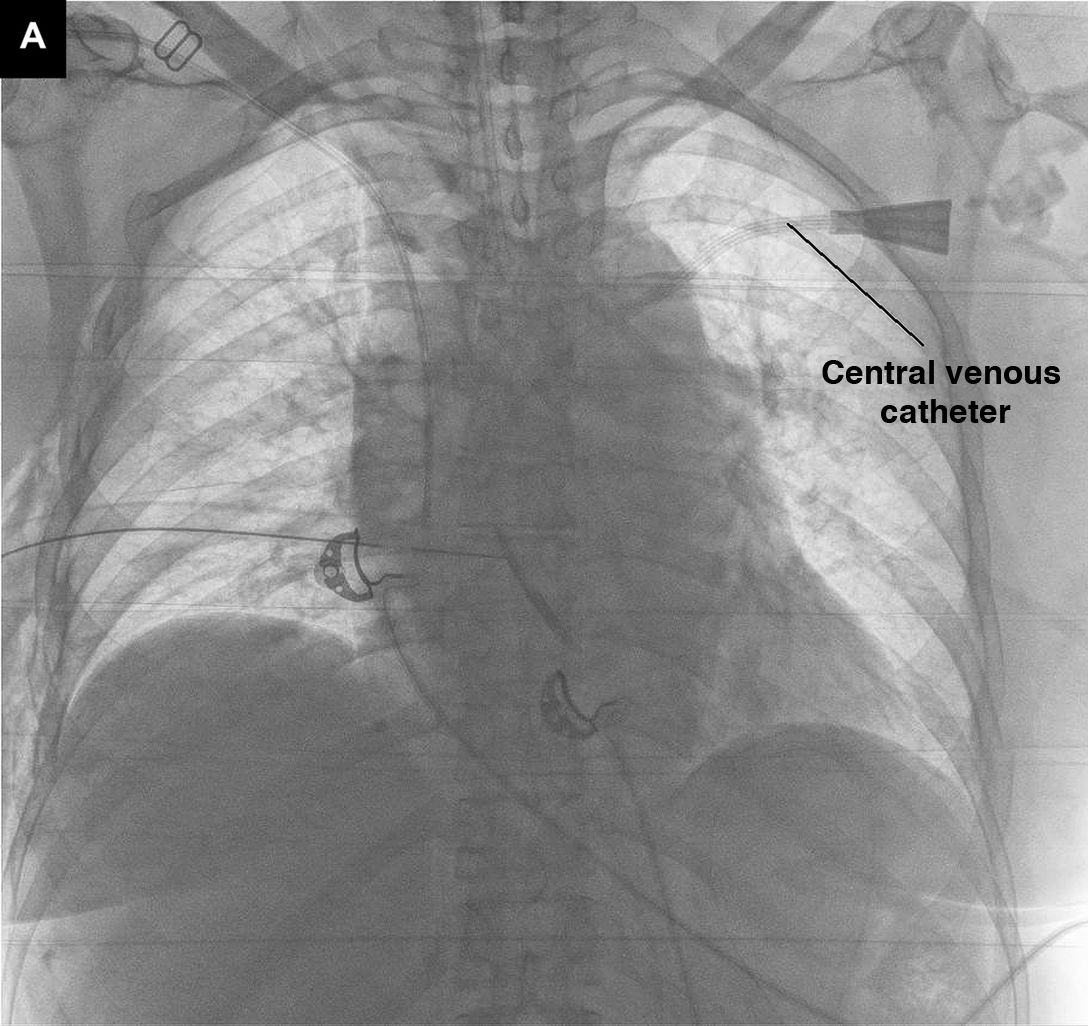
Male patient with severe thoracic trauma and hemorrhagic shock was transferred to the ICU with only a small-caliber peripheral venous access. A high-flow central venous catheter (CVC) was placed via left subclavian vein, but the thoracic ascending aorta was accidentally cannulated on its anterolateral surface at the lesser curvature (Fig. 1A: anteroposterior chest X-ray showing the CVC entering the circulatory system through the aortic knob; Fig. 1B: 3D reconstruction from a thoracic CCTA). Once the patient was stabilized, the catheter was removed through a minithoracotomy using 2 pericatheter purse-string sutures to close the defect without complications.

Figure 1

The systematic use of real-time ultrasonography significantly reduces the risk of arterial puncture; however, it requires both experience and time. In this context, intraosseous access has been recognized as a safe and effective option.

CRediT authorship contribution statement

All authors contributed equally to the conception, drafting, and final approval of the scientific communication.

Ethical considerations

The authors adhered to the journal’s instructions for authors and to ethical responsibilities. All hospital protocols and procedures related to the publication of patient data and subject privacy were followed.

Funding

None declared.

Declaration of competing interest

None declared.

Copyright © 2025. Elsevier España, S.L.U. and SEMICYUC
Download PDF
Idiomas
Medicina Intensiva (English Edition)
Article options
Tools